LPRM Researcher at DCOSS-IoT 2026 — Reykjavik, Iceland.
The LPRM Researcher Vinícius Mota recently participated in the 22nd IEEE International Conference on Distributed Computing in Smart Systems and the Internet of Things (DCOSS-IoT 2026), held in Reykjavik, Iceland, from June 22 to 24, 2026. The conference brought together researchers working on distributed computing, IoT, machine learning, security, and smart systems.
During the co-located UrbCom 2026 workshop (8th International Workshop on Urban Computing), he presented three papers, which are results of the Project CNPq Artificial Intelligence as an Enabler for Privacy & Security in the Internet of Things:
Beyond dashboards: Promoting urban data visualization for citizens
Authors: Marcela Almeida, Liziane Jorge, and Vinicius Mota
This paper emerges from a multidisciplinary project where students from Computer Engineering, Architecture, and Urban Planning are challenged to design and develop urban data visualization solutions for citizens. The initiative promotes collaboration across disciplines, encouraging students to think beyond conventional dashboard interfaces and produce tools that make urban data genuinely understandable and actionable for the general public. The work reflects the outcomes of one such project, demonstrating the potential of interdisciplinary education in producing research-relevant contributions.
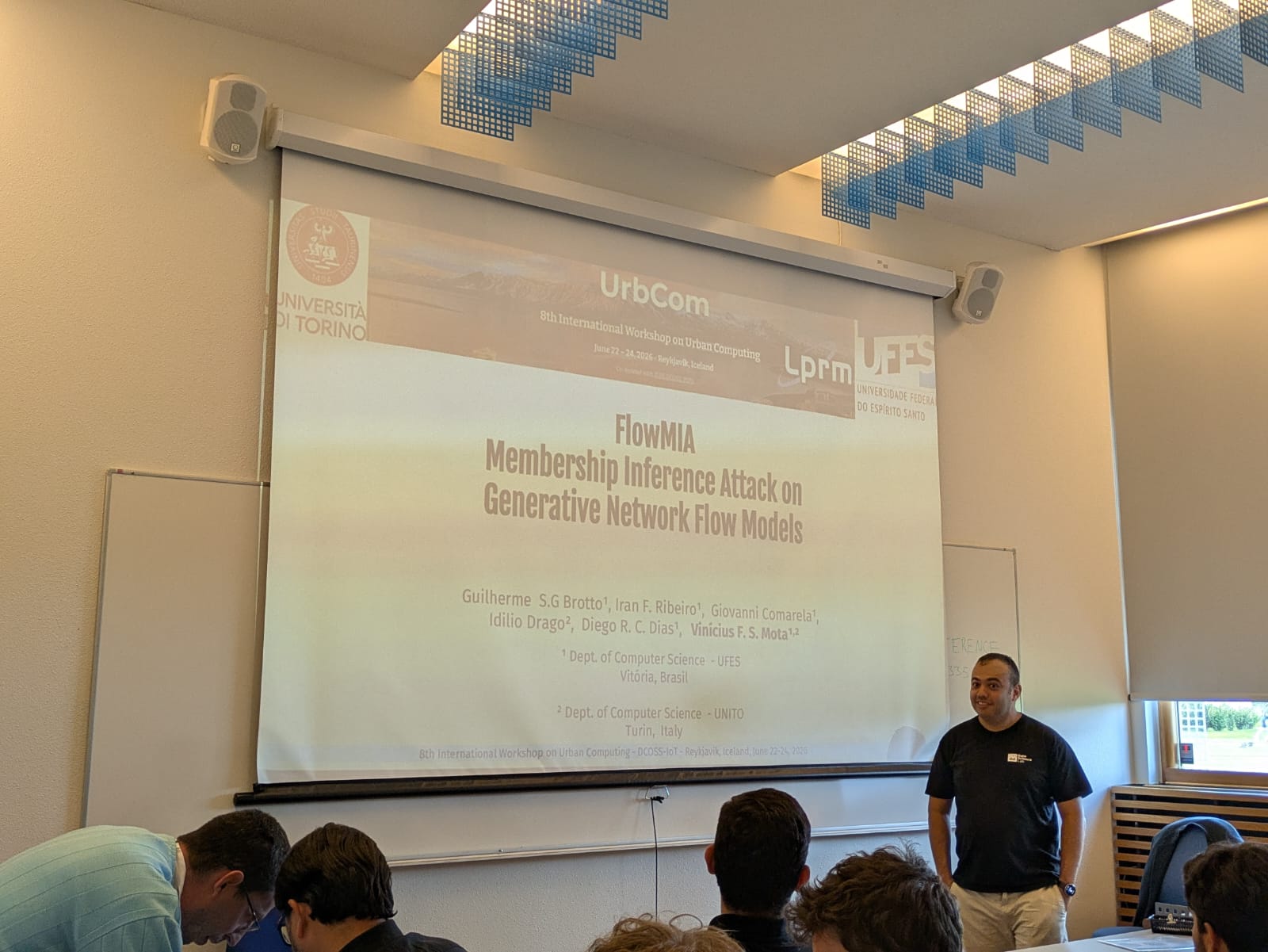
FlowMIA: Membership Inference Attack on Generative Network Flow Models
Authors: Guilherme Brotto, Iran Ribeiro, Giovanni Comarela, Idilio Drago, Diego Roberto Colombo Dias, and Vinicius Mota
A special highlight of the workshop was FlowMIA, which resulted from the work of undergraduate student Guilherme Brotto during his time at the University of Turin, where the study was developed as his final course project. The paper presents a membership inference attack against generative models trained on network flow data, showing relevant privacy risks in this setting and illustrating the strong research potential of undergraduate projects.
Are federated and centralized models alike? A comparative study via XAI
Authors: Antonio Borssato, Daniel Trindade, Giovanni Comarela, Eduardo Zambon, Vinicius Mota, and Diego Roberto Colombo Dias
This work investigates whether federated and centralized learning models produce equivalent results, using explainability techniques as the main analytical perspective.
Participation in DCOSS-IoT 2026 provided an excellent opportunity to share ongoing research and strengthen collaborations in areas such as federated learning, privacy, urban computing, and network data analysis.